Why Luxury Brands Are Moving from AI to Hand-Drawn Illustration
Is the love affair with AI over? Discover why hand-drawn, human-made design is the ultimate marker of exclusivity for luxury brand packaging and authentic identity.
Published on:
March 25, 2026
Why Luxury Brands Are Abandoning AI for Hand-Drawn Botanical Illustration
Is the love affair with AI design over? In this article I examine why hand drawn, human made design is the way forward for luxury brands packaging.
“As AI-generated graphics and hyper-digital perfection dominate the visual landscape, consumers increasingly crave something real that feels like it came from a person, not a program. This approach leans into emotional resonance, making packaging feel more personal, honest, and crafted”
- Smash Brand, December 2025
Brands vs consumers - the Authenticity gap
The world is saturated with constant imagery and information about what to buy and why. Heritage and luxury brands risk being caught in a trap - either playing it safe with generic botanical decorations or following trends to stay modern.
Meanwhile, educated consumers are increasingly looking for authentic messaging from their favourite brands. However, between the brands and consumers, a huge authenticity gap exists. Research shows that 92% of marketers believe most, or all of their content, resonates as authentic with consumers. Yet 57% of consumers say less than half of brands create authentic content. (2019 Stackla report)
Brands want to come across as authentic. But because they prioritise trends over their story, they come across inauthentic. They're not asking: 'What is our story? What makes us unique?' Instead they're asking: 'What's trending right now? Is AI hype the thing to follow?
When a package looks too perfect, too generic, or makes grand claims without proof, consumers don't just ignore it. They actively distrust it. This creates negative brand perception where the mere suspicion of AI-generated or trend-chasing design makes consumers find an ad "boring" or "annoying." (NielsenIQ, 2024)
Hand-drawn illustration is not just a style, it is an antidote to that mistrust. Coupled with brand storytelling, it makes an explosive branding combination. An increasing amount of luxury brands already understand this.
Hand-drawn signals luxury
If anyone could just type a prompt on their computer and turn it into an amazing, meaningful product design, there would be no more need for creatives. However, design isn’t just visual - people are drawn to design for the feeling it conveys, the trust it creates, and the story it tells.
While the debate over AI-generated art rages on, luxury brands aren't waiting. They are already grasping the differentiation effect - hand made design as a competitive advantage and a marker of prestige.
Why luxury brands are turning to hand-drawn design:
Authenticity feeds consumer trust - 71% of consumers purchase from brands aligned with their values
Bespoke illustration elevates a product - hand drawn transforms the product from a commodity to a craft.
Imperfection makes design relatable - an organic, imperfect line displays our innate human quality and makes the design resonate.
Storytelling creates emotional connection - shared experiences can connect us emotionally to the brand - AI cannot relate to feelings as an authentic storyteller.
Visible craftsmanship = premium positioning - The evidence of craftsmanship in design including hand-drawn detail and intentional design choices reinforce the premium positioning of the brand and their product
Examples of crafted branding vs ‘blanding’
Philosophy and Opihr - human made brand design
Philosophy
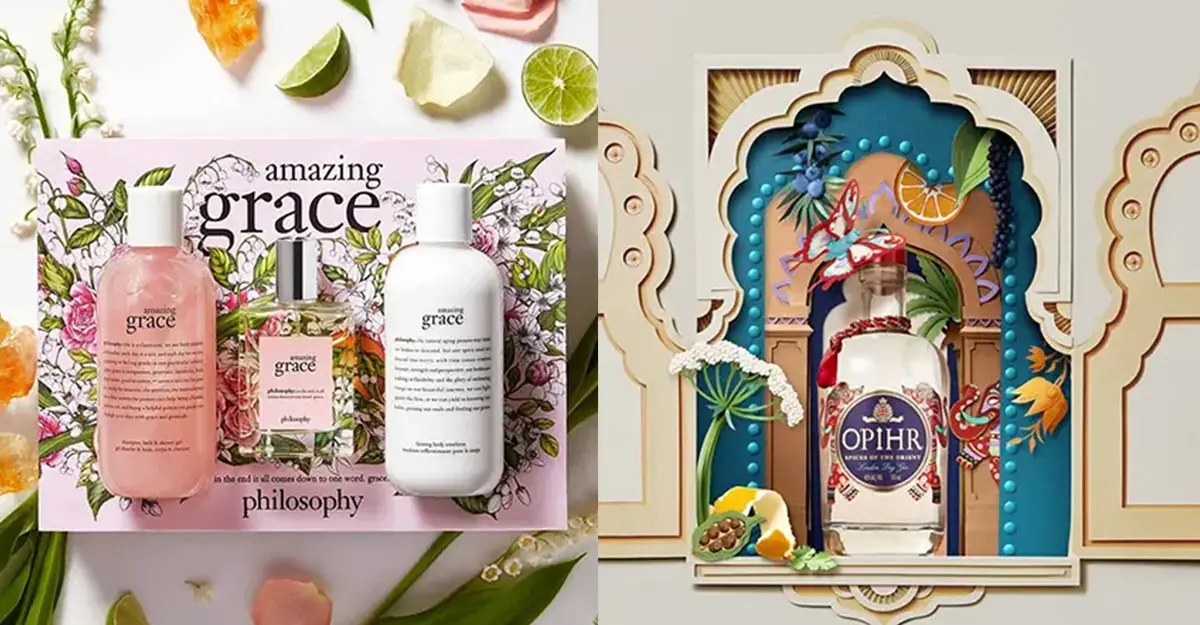
Dense botanical illustrations for Philosophy packaging by Maggie Enterrios - the use of botanical illustration along with storytelling highlights the element of craftsmanship in Philosophy’s botanical packaging range. The primary objective was to create botanical patterns that highlighted the scent note ingredients specific to each collection. The rich illustration contrasts the simplicity of the product packaging itself and tells the product story.
Opihr
Premium gin brand Opihr wanted to capture its adventurous spirit and botanical origins in a single image by Helen Musselwhite, resulting in a tactile piece (painted and cut out of paper) of brand storytelling. The brand even made an animation from the design, which further reinforces the product story and its emotional connection to the brand.
Like Philosophy and Opihr, a growing number of luxury brands are embracing hand crafted design, so they can differentiate themselves from the generic design (‘blanding’) dominating the market. In this respect, luxury and heritage brands have an inbuilt advantage. They have extensive photo libraries, rich customer relationships, and deep heritage to draw stories and design inspiration from. This positions them perfectly to convey their uniqueness whilst distancing themselves from generic AI design.
Because AI can now produce 'perfect' imagery instantly, perfection no longer signals quality. In 2026, authenticity is being redefined by ‘human messiness’, of which hand drawn illustration is the best representation. When you add a strong narrative to this, luxury brands are poised to stand out from their competitors in a meaningful way.
BGSU research published in Psychology of Aesthetics, Creativity, and the Arts (2023) discovered that even when people could not consciously tell the difference between AI and human art, they still scored human made art higher in categories including attraction, nostalgia, amusement, and self-reflection. So your limbic system (your emotional center) can intuitively detect the lack of human intentionality. This follows from consumers trusting and preferring human-made design over AI.
“75% of consumers are more likely to buy from brands with a strong narrative ”
In the heart of design, there is a process; a method to follow to make the design the best it can be. Creating a hand drawn design for luxury brands is a collaborative process between two humans, at minimum. It's a discussion of values, style and messaging - back and forth discussion - an emotional dance almost. AI doesn’t care who you are, and what story you are trying to convey. It doesn’t care whether your design is able to connect with, or talk to another human being. AI is inherently a data compiler, not a designer. Data processing does not require emotions, unlike design, which thrives from it. This is where my own design methodology comes in.
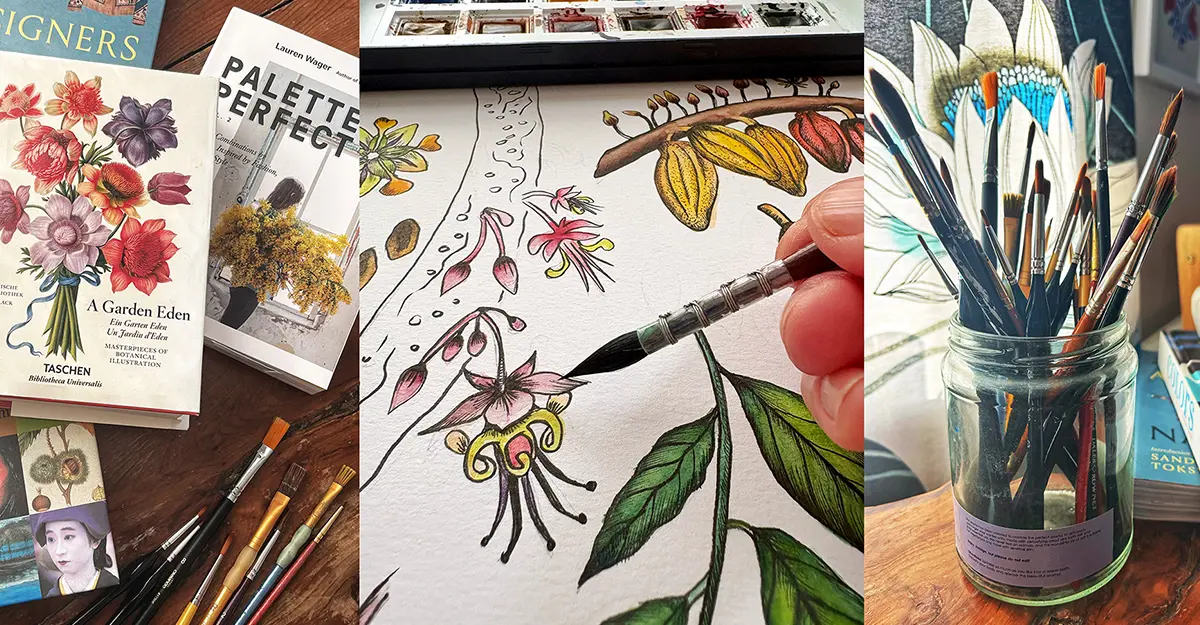
My own bespoke design process is always hand crafted, story-led and with a strong focus on what your brand wants to convey. In order to help heritage brands tell their unique story through research-led botanical illustration, I lean into my commercial design and filmmaking experience.
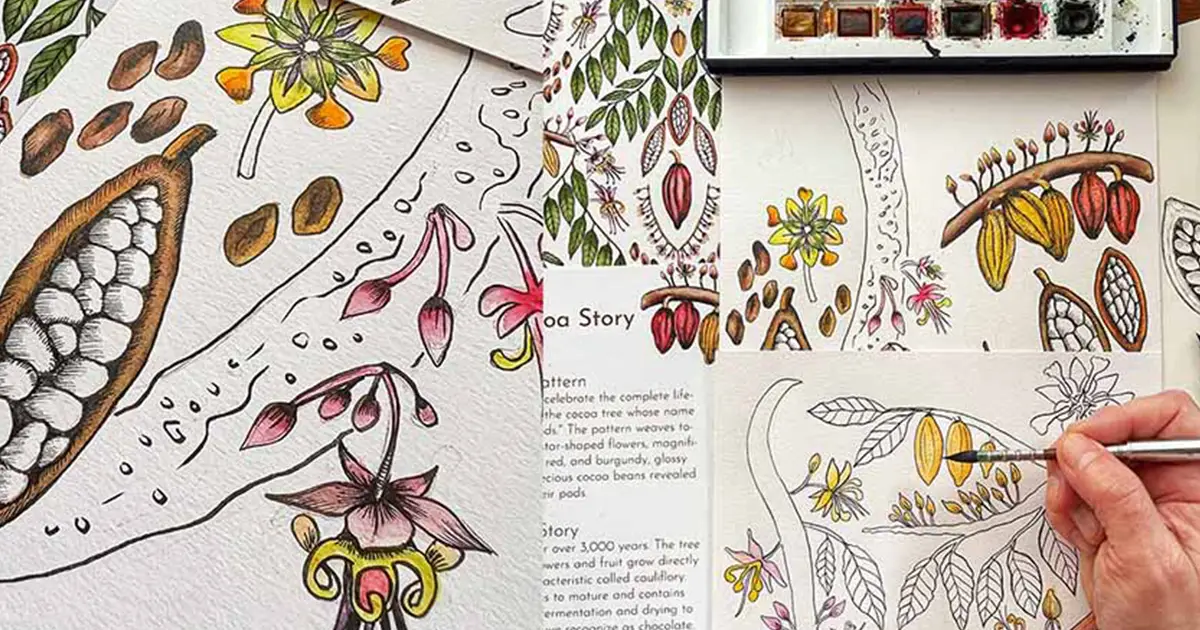
This story-driven design process is documented at all stages and can be made into a short animation or a ‘Brand Story Film’ - which reinforces the intentional authenticity of your brand. Beyond being a cinematic asset, the short film acts as a supply chain proof of the hand-made design process and shows the bones of your brand through the documented research stage.
To see how I animate an illustration for the use as a visual asset, please see my packaging design for Ethiopian shade-grown coffee: Wild Mountain
Case Study - the Cacao Story
My research and story driven Roots To Bloom™ method
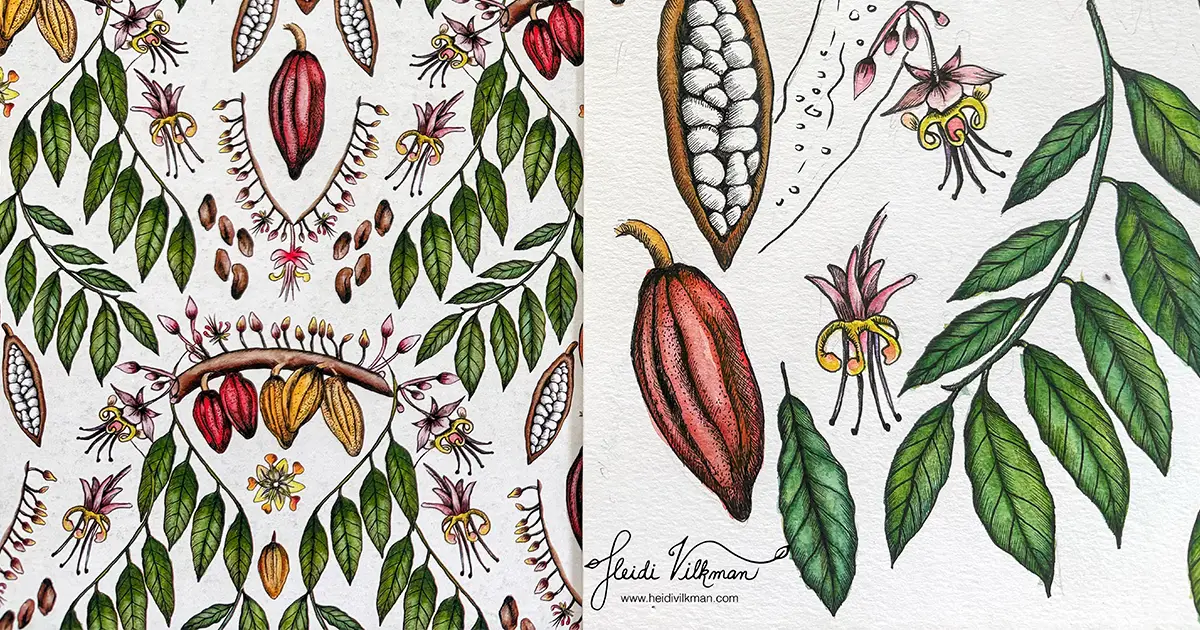
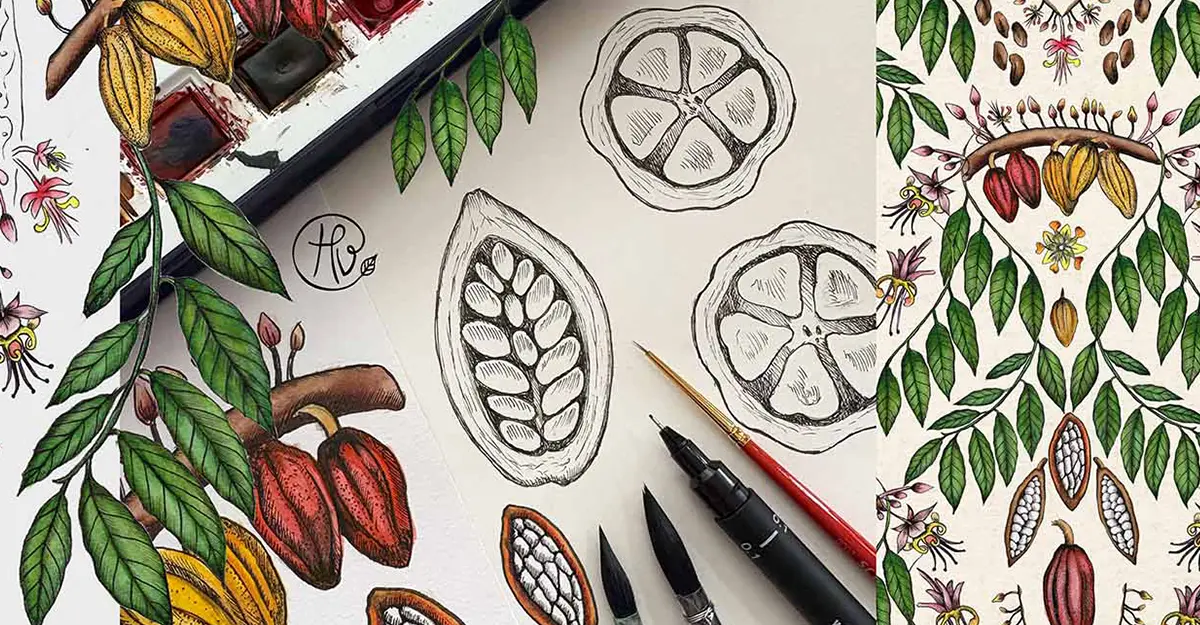
I created the Cacao Story collection because despite its ancient cultural roots, the origin of cacao* is largely invisible to the majority of consumers. Despite being a billion-pound global industry, most people don’t know where cocoa* comes from, how it grows, or what the life cycle of Theobroma Cacao (translated as: food of the gods) looks like. I wanted to reconnect consumers to the plant’s natural origins and show a glimpse of its intriguing ecosystem.
(* see footnote on cocoa/cacao)
For the collection, I researched cacao plantations, their growing regions, the fascinating botanical details of the plant in its different life cycles. I also looked into the plant’s pollination relationships and its mythological roots and its cultural significance. (Did you know that in Mayan times, the beans were an actual currency - you could buy a rabbit for 10 beans?)
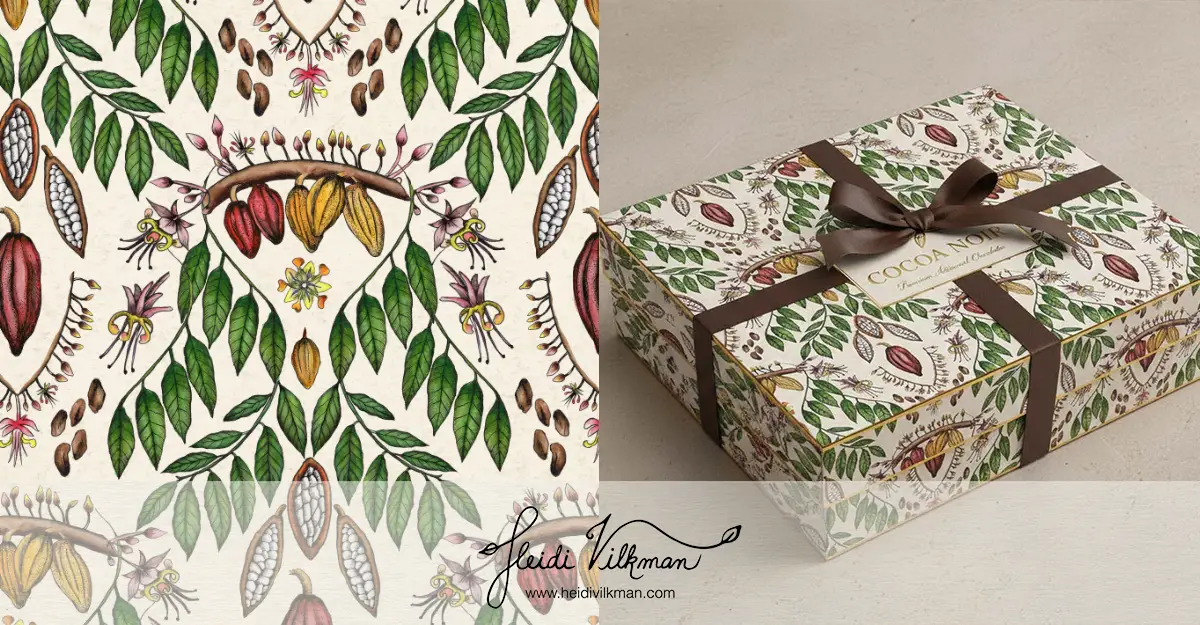
Even though cocoa is now a commodity, its story from seed to product is most certainly a craft. I wanted to honour this craft with expressive ink drawing and hand painted watercolour textures, bringing in tactile credibility. The completed patterns are a homage to the botanical beauty that is the life of the cacao plant.
The power of research-led biophilic design narrative is that it creates a story arc, a genuine emotional resonance and a dose of curiosity. Beyond a pretty picture, a storytelling design invites its audience in, weaving them into the story the brand is revealing.
“Facts may inform, but stories transform. ”
- Brad Harmon
Conclusion
Hand drawn design in luxury packaging is a differentiator in the world of brand sameness. Brand storytelling through bespoke botanical illustration is how luxury brands create authentic emotional connections and stand out from their competitors. Consumers are increasingly interested in authenticity, human made design and emotional storytelling. The brands that listen to their customer base will be the ones that will be established as the industry leaders. When luxury brands choose craftsmanship and story, they set the standard for the entire industry to follow.
The heavy use of AI and generic design is highlighting those brands who choose differently, who choose human made ‘slow design’ as a way to define 'quiet luxury'. Gen in AI stands for ‘generative’ but in luxury packaging it could as easily stand for ‘generic’. In today’s competitive world, brands want to be anything but that.
About me
I am Heidi, a biophilic surface pattern designer. I combine a decade of design experience, a filmmaker's mindset, and my clear design method to help lifestyle brands stand out with considered, human-made design.
*Cacao is referring to the botanical name of the plant - Theobroma Cacao whereas cocoa is the name of the bean and the rich, finished essence we’ve come to love in chocolate.